
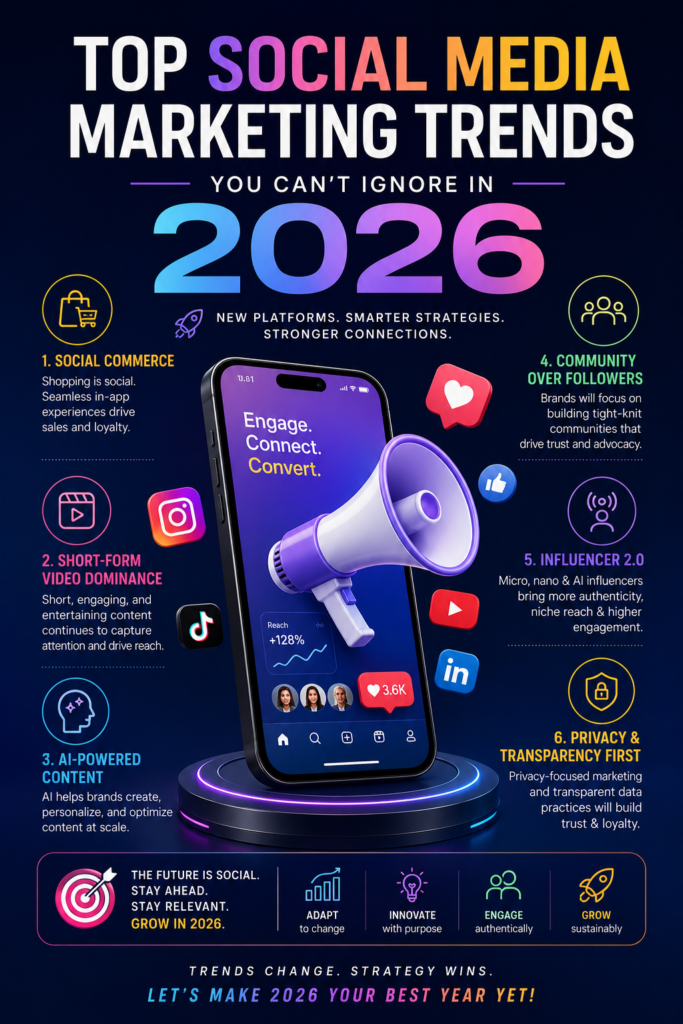
Top Social Media Marketing Trends You Can’t Ignore in 2026
Primary Keyword: Social Media Marketing Trends 2026
Secondary Keywords: Social media strategy 2026, AI in social media marketing, social commerce trends, short-form video marketing, influencer marketing 2026, social SEO, community management social media
Published: June 2026 | Reading Time: ~10 minutes | Category: Social Media Marketing
Introduction
Social media marketing in 2026 is not the same game it was even two years ago. Algorithms have matured, audiences have grown smarter, and the lines between content discovery, entertainment, and shopping have completely blurred. If you’re still running your brand on a 2023 playbook, you’re already behind.
The good news? The social media marketing trends of 2026 are not just about chasing new features or hopping on viral challenges. They are about building deeper connections, using technology more intelligently, and creating content that earns genuine trust from your audience.
Whether you’re a business owner, a content creator, or a marketing professional, understanding these trends is the difference between a strategy that drives real results and one that gets lost in the noise.
In this blog post, we break down the top social media marketing trends you simply cannot ignore in 2026 — and more importantly, what you can do about each one.
1. AI-Powered Content Creation is Now the Standard — Not the Shortcut
Secondary Keyword: AI in social media marketing
Artificial Intelligence has moved from being a novelty to being deeply embedded in every layer of social media marketing. In 2026, AI fluency is no longer optional for marketers — it is a baseline skill expected across the industry.
Brands are now using AI tools to generate content ideas, write caption variations, schedule posts at optimal times, analyse audience sentiment, and even create visual assets. What was once a time-consuming process is now a streamlined workflow.
However, there is an important nuance here. A Sprout Social survey found that over 52% of social media users are concerned about brands publishing AI-generated content without disclosing it. This means transparency is becoming a non-negotiable expectation.
What this means for your strategy:
- Use AI to assist your creative process, not replace your human voice
- Disclose AI use where appropriate, especially for visual or video content
- Focus your efforts on the creative direction and final editing — let AI handle the repetitive groundwork
- Upskill in AI fluency, as this is now one of the most in-demand capabilities in digital marketing
The brands winning in 2026 are treating AI as a co-pilot, not an autopilot. Strategic control stays firmly with the human.
2. Short-Form Video Remains King — But Long-Form is Making a Comeback
Secondary Keyword: Short-form video marketing
Short-form video content has dominated social media for the past few years, and it continues to be the highest-performing content format in 2026. Platforms like TikTok, Instagram Reels, and YouTube Shorts reward concise, engaging clips that hook viewers in the first two to three seconds.
But here is what is changing: audiences are now craving depth. Long-form video content is experiencing a quiet resurgence, especially on YouTube and LinkedIn, where users are willing to spend more time with content that genuinely teaches them something or tells a compelling story.
The smart social media marketing strategy in 2026 is not to choose between short and long-form — it is to master both and use them for different parts of the customer journey.
What this means for your strategy:
- Use short-form video (15–60 seconds) to capture attention and drive discovery
- Repurpose long-form content into short clips to extend reach across platforms
- Invest in storytelling — raw, authentic, mobile-shot content consistently outperforms heavily produced videos in engagement
- Add captions to all videos, as a majority of users watch without sound
User-generated and creator-led video content continues to outperform traditional brand creatives significantly, making authenticity a performance signal, not just a preference.
3. Social SEO: Your Content Must Be Discoverable, Not Just Engaging
Secondary Keyword: Social SEO
One of the most significant social media marketing trends of 2026 is the rise of social media as a search engine. Younger audiences in particular, particularly Gen Z, now turn to TikTok, Instagram, and even Pinterest before they open Google.
This shift means that keyword strategy is no longer reserved for blog posts and websites. Your social media captions, hashtags, video titles, and even spoken words in videos now need to be optimised for search intent.
Social SEO in 2026 involves understanding what your target audience is searching for on each platform and making sure your content appears when they look for it. Platforms are increasingly rewarding interest-aligned content, delivering posts to users based on their behaviours and search patterns rather than just who they follow.
What this means for your strategy:
- Research platform-specific keywords using tools like TikTok’s search bar, Instagram’s Explore page, and Pinterest trends
- Write captions as if they are mini blog posts — include your primary keyword naturally in the first line
- Use relevant hashtags strategically (3–5 targeted ones outperform 30 generic ones)
- Optimise your profile bio with keywords that describe exactly what value you provide
- Speak your keywords aloud in videos, as platforms now index spoken audio for search
4. Social Commerce is Reshaping How People Buy Online
Secondary Keyword: Social commerce trends
Social commerce — the ability to discover and purchase products without leaving a social media platform — is no longer a future trend. In 2026, it is a core channel for e-commerce brands across every category.
Shoppable videos, in-app checkout features, and live shopping events have become essential tools for brands that sell physical products. Facebook remains a major player, with nearly 40% of consumers using it to discover new products, while TikTok Shop and Instagram Shopping continue to grow rapidly.
Affiliate marketing is also becoming the dominant payment model for creator partnerships, as brands look for more performance-driven ways to collaborate with influencers. Affiliate structures allow brands to tie creator compensation directly to sales outcomes, making ROI easier to measure.
What this means for your strategy:
- Set up Instagram Shopping and TikTok Shop if you sell physical products
- Experiment with live shopping events — they combine entertainment with instant purchase capability
- Build affiliate partnerships with creators who have genuine influence over your target audience
- Make your product content feel native to each platform, not like a traditional advertisement
5. Community Management is the New Growth Strategy
Secondary Keyword: Community management social media
For years, brands focused almost entirely on broadcasting — publishing content and hoping for reach. In 2026, the social media marketing trend has shifted dramatically toward conversation and genuine community building.
Audiences want meaningful interaction, not just polished content. A Sprout Social report revealed that 93% of consumers want brands to prioritise actively engaging with their audiences. This means responding to comments, joining conversations, acknowledging feedback, and building spaces where followers feel a genuine sense of belonging.
Community management is no longer a customer service function — it is a growth strategy. Brands that invest in real conversations are building the kind of loyalty that no paid ad can replicate.
What this means for your strategy:
- Dedicate time daily to responding to comments and direct messages — even a simple reply makes a significant impact
- Create community spaces on platforms like Facebook Groups, Discord, or LinkedIn communities
- Ask questions, run polls, and create content that invites participation rather than passive scrolling
- Celebrate and reshare user-generated content — it rewards your audience and signals authenticity
6. Influencer Marketing Evolves: Micro and Nano Creators Lead the Way
Secondary Keyword: Influencer marketing 2026
Mega-influencers with millions of followers are still relevant, but the most effective influencer marketing in 2026 happens at the micro and nano level. Creators with audiences of 5,000 to 100,000 followers consistently deliver higher engagement rates, stronger trust, and better conversion outcomes for brands.
Why? Because their audiences are smaller, more niche, and more deeply connected to the creator. A recommendation from a trusted micro-influencer in your specific niche carries far more weight than a sponsored post from a celebrity with a broad, disconnected following.
Simultaneously, brand-creator relationships are becoming more sophisticated. Experiential and social marketing are increasingly intertwined, with brands partnering with creators not just for posts but for real-world events, product collaborations, and long-term brand partnerships.
What this means for your strategy:
- Shift budget from one or two large influencer deals to multiple micro-creator partnerships
- Look for creators whose values genuinely align with your brand, not just their follower count
- Build long-term relationships rather than one-off campaigns — consistency builds trust
- Track performance through affiliate links, promo codes, and platform analytics
7. Authenticity Beats Perfection — Every Single Time
One of the clearest social media marketing trends of 2026 is that audiences have developed a highly refined radar for anything that feels fake. Years of polished, over-produced brand content have created a massive appetite for the real, the raw, and the imperfect.
Lo-fi content — mobile-shot footage, natural lighting, minimal editing, conversational delivery — consistently outperforms studio-quality productions in terms of engagement and trust. This does not mean quality does not matter; it means that relatability and honesty now outrank aesthetic perfection.
Brands that are willing to show their process, share their values, admit mistakes, and give audiences a genuine behind-the-scenes look are building the audiences that competitors with bigger budgets cannot buy.
What this means for your strategy:
- Post more raw, unfiltered content — stories, behind-the-scenes clips, founder-led posts
- Share your brand’s values and take a genuine stance on issues that matter to your audience
- Use real customer reviews, testimonials, and user-generated content as social proof
- Stop waiting for perfect — publish consistently and let authenticity do the work
8. LinkedIn and Substack Are Emerging as Serious Content Platforms
While TikTok and Instagram dominate conversations about social media trends, two platforms are quietly becoming essential for professional marketers and B2B brands in 2026: LinkedIn and Substack.
LinkedIn has introduced new video features and is attracting a younger, more engaged audience than ever before. For B2B brands, thought leaders, and professional service providers, LinkedIn now offers reach and engagement opportunities that rival any other platform. Personal brands built on LinkedIn are proving to be one of the most effective lead generation tools in the B2B space.
Substack, originally known as a newsletter platform, has evolved into a full social network complete with feeds, comments, and direct community engagement. Its growth signals a wider trend of audiences seeking curated, in-depth content from trusted voices rather than algorithm-driven feeds.
What this means for your strategy:
- Invest in a consistent LinkedIn presence if you serve a professional or B2B audience
- Consider launching a Substack newsletter to build a direct, owned audience relationship
- Focus on thought leadership content that demonstrates expertise rather than just promotional material
9. Data, Analytics, and Proving ROI Are Non-Negotiable
As social media marketing matures, the pressure to demonstrate measurable return on investment has never been higher. In 2026, simply reporting on vanity metrics like likes and follower counts is no longer acceptable. Brands and clients want to see tangible business outcomes: leads generated, revenue attributed, customer acquisition costs, and lifetime value.
The good news is that social platforms are continuously improving their native analytics tools, and third-party platforms like Sprout Social and Hootsuite offer increasingly sophisticated reporting capabilities.
Marketers who understand how to interpret data, translate it into insights, and use those insights to refine strategy are the ones advancing rapidly in their careers and delivering the most value to their clients.
What this means for your strategy:
- Define your social media KPIs clearly before launching any campaign — what does success actually look like?
- Track metrics that tie back to business goals: website traffic, leads, sales, email sign-ups
- Use UTM parameters on all social media links to properly attribute conversions in Google Analytics
- Review your analytics weekly and use the data to guide your content decisions
10. Platform Diversification: Don’t Build Your Audience on Rented Land
One of the most important lessons for social media marketers in 2026 is the danger of building entirely on platforms you do not own. Algorithm changes, platform policy updates, and shifting user behaviour can dramatically reduce your reach overnight — and if your entire audience lives on a single platform, that is a significant business risk.
The smart social media strategy in 2026 involves building on social platforms while simultaneously driving audiences toward owned channels: email lists, websites, podcasts, and communities you control.
What this means for your strategy:
- Treat social media as the top of your funnel, not the entire funnel
- Consistently drive your social audience to sign up for your email list
- Diversify across 2–3 platforms rather than going all-in on a single one
- Build a content hub on your own website that you own and control long-term
Conclusion: The Social Media Marketing Landscape of 2026 Rewards the Strategic
The social media marketing trends of 2026 share a common theme: depth beats breadth, authenticity beats perfection, and strategy beats volume. The brands and marketers who will win are those who deeply understand their audience, create content with genuine value, and use technology to enhance — not replace — their human creativity.
From the rise of AI-assisted workflows and social SEO to the evolution of influencer marketing and the resurgence of community building, 2026 is a year of tremendous opportunity for marketers who are willing to adapt, learn, and experiment.
The question is not whether these trends matter. The question is which ones you will act on first.
Quick Recap: Top Social Media Marketing Trends 2026
- AI-powered content creation as the new baseline
- Short-form video dominant, long-form returning
- Social SEO as a core content strategy
- Social commerce and shoppable content
- Community management as a growth lever
- Micro and nano influencer partnerships
- Authenticity and lo-fi content winning
- LinkedIn and Substack as emerging platforms
- Data-driven decision making and ROI measurement
- Platform diversification and owned audience building
Found this article helpful? Share it with your network or drop a comment below. If you’re looking to level up your digital marketing strategy in 2026, explore the rest of our blog for more practical guides and expert insights.
Tags: Social Media Marketing Trends 2026, AI in Social Media, Social Commerce, Influencer Marketing 2026, Short-Form Video, Social SEO, Community Management, Digital Marketing Strategy